1840's - 1900
As the Catholic population of Folkestone grew, mainly as a result of the influx of Catholic workers who arrived from Ireland to build the London to Dover railway line, it became clear that there was need for a Catholic place of worship. During the earlier years, Mass was celebrated in private houses.
Around 1860 a building, which had earlier served as an office for Mr. Hart, a lawyer, was purchased and converted into a chapel. The building stood on the south side of Martello Street and the tiny chapel was dedicated to St. John the Evangelist.
The St John chapel was indeed small, accommodating about sixty persons, half of them had to stand. The little building also served as the first Catholic school in Folkestone, the sanctuary being screened off from the body of the chapel for the purpose.
As the size of the Catholic community was rapidly outgrowing the capacity of the tiny Chapel, some time in 1869 a construction of a new Chapel commenced. The opening service at the new building took place on Sunday 31 January 1870. Once again, an extension to the Chapel was screened off and used as a schoolroom.
Plans for a New Church
In 1874, Bishop Danell purchased a plot of land in Folkestone and in 1883 his successor, Bishop Coffin, visited Fr Cahill to discuss the possibility of building a new church on the site. Between 1880 and 1884 different sites were considered, including one which was to become Kingsnorth Gardens in 1927.
In 1885 the firm plans were made to construct a Church in the site at Townsend.
The New Church
In the 1880s, Townsend was a rapidly developing area, and the local authorities were anxious to improve the width of what had by then become Guildhall Street. Mr. Leonard Aloysius Scott Stokes was finally engaged as architect. In August 1888 the work of constructing the new Church had begun. By the summer of 1889 all was ready.
"The Church is a substantial building in the early Gothic style. It is built of local red bricks with Bath-stone dressings and has two towers. In the space between the towers is a very handsome Gothic window, one of the main features of the building. The wall above - like the towers - has a parapet battlement in stone and is surmounted by a gable with a stone cross at the apex."
Opening Day: 17 July 1889
The morning of Wednesday 17 July dawned with clear blue skies and bright sunshine. As the Catholic community gathered outside the new Church there was an atmosphere of 'gladness and delight'.
Admission was to be by ticket only - such tickets being obtained from the Presbytery or from the offices of 'Holbein's Visitors List' in George Lane. At 10.45 the doors were opened to admit the congregation and all were in their places before the stated deadline of 11.15.
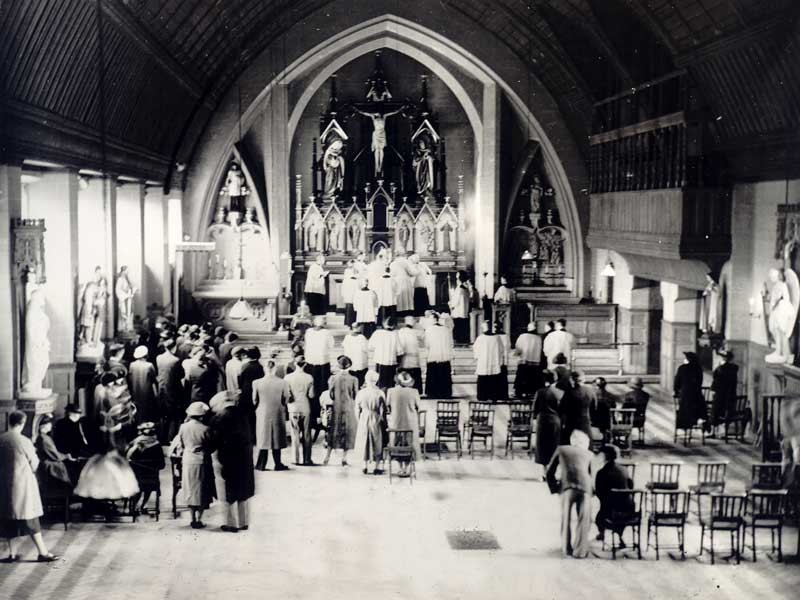
"The main altar is a magnificent piece of workmanship, carved in oak by Meyer of Munich. Above is a large crucifix and statue of the Virgin and St John and below in an arcading are paintings representing St Augustine, St Andrew, St Patrick, St Lawrence and St Francis of Assisi. On the front of the Altar table is a beautiful reproduction of Da Vinci's great painting, 'The Last Supper'."
At 11.30 the service started. The seating accommodation proved hardly adequate and all 750 places had been taken. The Opening Ceremony included a procession, blessing from the Bishop of Southwark, High Mass and the performance by a number of choirs. This was followed by an afternoon reception in the old schoolrooms.
The Amalgamation: 2016
The Parish of Our Lady, Help of Christians, Folkestone and the Parish of Saint Joseph, Cheriton were amalgamated by Decree of Archbishop Peter Smith, ever mindful of the requirement to provide the best pastoral care for the faithful, on 4 October 2016 and named the Parish of Our Lady and St Joseph's Folkestone.
The parish of Saint Joseph was made up of Saint Joseph's church at Cheriton and the chapel at Saint Mary's Convent School, Folkestone. Saint Mary's school was run by the nuns of the congregation of Our Lady of Fidelity. Both places of worship served the people of Cheriton, the residents of Shorncliffe barracks and part of the West End of Folkestone. Both Saint Mary's school and the Shorncliffe barracks were closed prior to 2016. The nuns of Our Lady of Fidelity have continued to provide excellent service for the people of Folkestone from their convent in Folkestone.
Parish Priests Who Have Served Our Lady Help of Christians Since 1889
Rev T.B. Scannell
1897 - 1905
Very Rev Mgr Charles Coote
1905 – 1935
Very Rev Canon James Walters
1936 – 1943
Rev Cyril Walmsley
1943 – 1969
Rev Laurence Roskilly
1969 – 1984
Rev Roger Nesbitt
1984 – 2012
Rev Stephen Bould
2012 - 2020
Rev Alex Saba
2020 - present
Bibliography
The history of the Parish is based on extracts from:
Catholic Folkestone, A Post-Reformation History by Eammon D. Rooney and Dennis Creighton-Davies
Copyright: Roman Catholic Parish of Our Lady and St Joseph, Folkestone